Home Is People
Also, circle stories, zooming in and out, circle visuals, and practicing gratitude

Hola mi gente,
This week’s newsletter is somewhat of a celebration of circles. They’ve been on my mind as of late. Maybe it’s because I’ve been listening to Mac Miller’s album Circles, or because I just read an essay by Ralph Waldo Emerson called Circles. Maybe it’s because there was just an election and it seems as though there are some people within my circle and some outside of it. Then again, maybe it’s the circular movements around me—the changing of the seasons or the cycling of the moon. Whatever the reason, I hope you read on and find something you’d like to circle and add to your list of things to check out.
Here are 5 “circular things” that I thought were worth sharing:
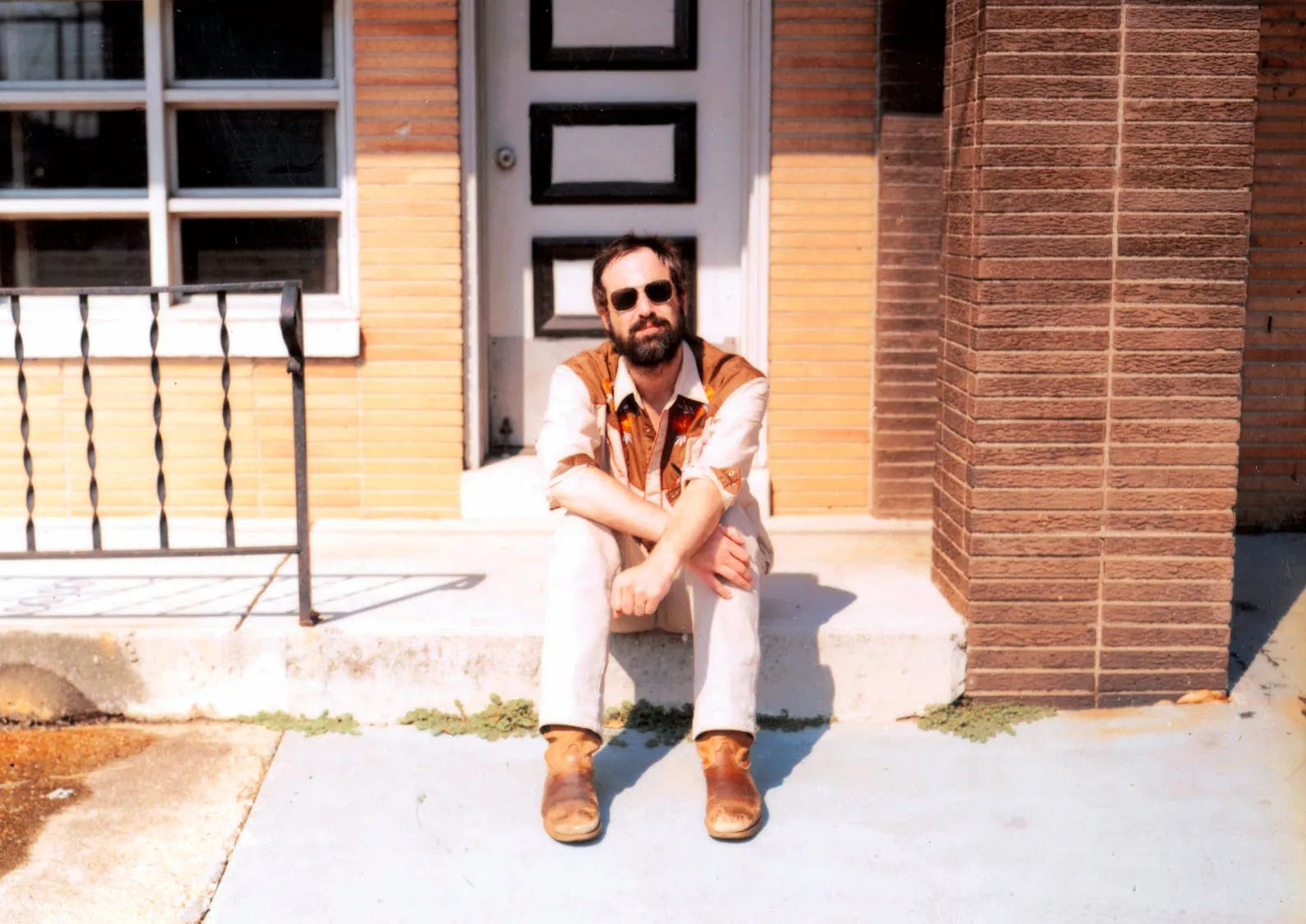
As Thanksgiving rolls around, it’s difficult to be away from home, and it’s got me thinking about what “home” really means. So I wrote a post called “Home Is People.” In the post, I take a look at David Berman’s poem “The Homeowner’s Prayer,” where he explores the circular and linear nature of time. And, I think he makes a point about how we should spend it. For wonderful advice on how to break free of some of the constraints of modern life, like time, check out Oliver Burkeman's book 4,000 Weeks: Time Management for Mortals and newsletter The Imperfectionist. I just started reading 4,000 Weeks and it’s excellent!
Emerson’s essay Circles starts out like this:
The eye is the first circle; the horizon which it forms is the second; and throughout nature this primary figure is repeated without end. It is the highest emblem in the cipher of the world. St. Augustine described the nature of God as a circle whose centre was everywhere, and its circumference nowhere. We are all our lifetime reading the copious sense of this first of forms.
(…)
Our life is an apprenticeship to the truth, that around every circle another can be drawn; that there is no end in nature, but every end is a beginning
In a previous newsletter I shared Julio Cortázar’s short story “Continuidad de los parques” (English version) and the animated short “Úlfur,” both of which move in a circle, tying the end to the beginning. As I was reading through more of David Berman’s poems, “Democratic Vistas” struck me as very similar to Cortázar’s story. One of my favorite sci-fi movies, Terry Gilliam’s 12 Monkeys, also moves in a circle. I recently learned that Gilliam based 12 Monkeys largely on the 1962 French film La Jetée, a minimalist 28-minute movie consisting of nothing more than 422 photos, a voiceover, and a score. I’d also recommend checking out “The Time Travel Movie That Doesn’t Go Anywhere” for an analysis of all the beauty found in La Jetée. The movie may not go anywhere, but it still moves in a circle.
I remember being really excited when Prezi first came out. As a language teacher, I often use graphic organizers to help students visualize concepts, and Prezi provided a cool way for students to zoom in on a part of the graphic to get more detailed information, or zoom out to get a bigger picture of how all the different parts of the graphic fit together. In Prezi, you could have circles within circles. It worked something like this. The ability to zoom in and out with respect to life is quite valuable. For example, in the song “Both Sides Now,” Joni Mitchell expresses an openness to the “not-knowing” that ironically comes with having more life experience and more diverse perspectives. She zooms out. Contrast this with Walt Whitman’s Song of Myself from Leaves of Grass, where he writes:
Do I contradict myself?
Very well then I contradict myself,
I am large, I contain multitudes.
We might say that Whitman zooms in. He looks within himself and finds that he can hold diverse and even contradicting perspectives simultaneously, in a similar way that Mitchell can while zooming out. It turns out that we might need a bit more contradiction in our lives. The Pew Research Center has found that as we grow more politically polarized to those outside of our circle, we are becoming more ideologically consistent with those inside of our circle. This contrasts greatly with how it used to be, when there was far more heterogeneity among different folks from within the same circle. This is to say, even though they were in the same circle, they wouldn’t all agree on the same issues. There would be some contradiction going on. I like the idea of zooming in to find difference and zooming out to also find difference. It seems to promote a more accurate view of how things actually are, instead of the sameness that all the talking heads would have us siloed into.
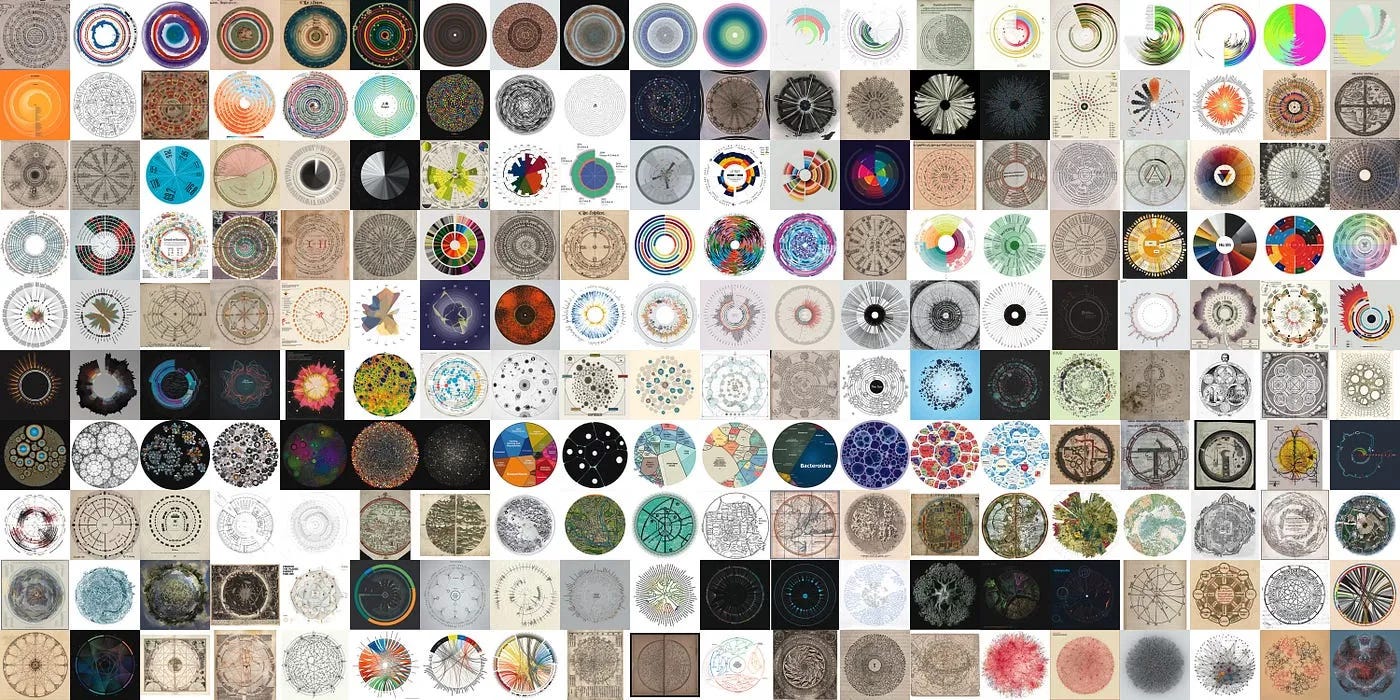
If you’re paying attention, circles are everywhere. I’m intrigued by The Book of Circles: Visualizing Spheres of Knowledge, by Manuel Lima, who provided a great time-lapse video of its contents. It’s a beautiful book that gives the reader…
A lively tour through millennia of circular information design. Three hundred detailed and colorful illustrations from around the world cover an encyclopedic array of subjects—architecture, urban planning, fine art, design, fashion, technology, religion, cartography, biology, astronomy, and physics, all based on the circle, the universal symbol of unity, perfection, movement, and infinity.
Also, check out “The Geometry of Circles,” the abstract Sesame Street animation scored by American composer and pianist Philip Glass in 1979. It’s mesmorizing!
Every day is a good day to practice gratitude. Thanksgiving always reminds me of that. One of my favorite songs that expresses gratitude is “Gracias a la vida” (Thanks to life), by Chilean singer-songwriter Violeta Parra. It’s been covered many times—by Joan Baez, for example, and more recently by Kacey Musgraves. NPR’s All Songs Considered is asking listeners to submit songs they are grateful for, some of which will be aired in an upcoming Thanksgiving Day episode (I submitted “Wichita Lineman,” so listen for it 😉). But I’m wondering, “What are some tangible things you can do to practice gratitude?” I like Austin Kleon’s idea for a Gratitude Zine (see this video for his 12-page version). I made a “Gracias a la vida” template for my Spanish students to practice gratitude. Another idea comes from professional storyteller Matthew Dicks, who suggests doing daily Homework for Life. This entails taking a few minutes before bed to write down story-worthy moments from your day (See here for a template I created). If you do this every night, over time you begin to realize that your life is a lot more interesting than you’d imagined, especially if you circle back periodically to revisit what you’ve written. You’re also better able to grab onto those small moments that often go unnoticed. This practice reminded me of Jeff Tweedy’s “rememories” that he’s shared in his newsletter Starship Casual and in his book World Within a Song. So, what are ways that you practice gratitude? If you have something you’d like to share, please leave a comment!
Thank you all for reading! I hope you found some inspiration for today’s moments, whatever they might be. If you enjoyed reading, go ahead and click subscribe to receive future newsletters.
If you know someone who might be interested in receiving this newsletter, please feel free to pass it along.
Be well and I hope to see you down the road sometime soon!
Eric