

It Comes in Waves
Also, a TED interview on creativity and loss, a refuge in grief, the shadow elephant, and "Not Broken"


Hola mi gente,
In his 1928 book Being and Time, German philosopher Martin Heidegger coined the term geworfenheit, or “thrownness”—the idea that we’re thrown into this world and into situations that are beyond our control and not of our choosing.
Oliver Burkeman talks about “thrownness” in his book Meditations for Mortals. He likens it to being in a one-person kayak floating down the river of time. All we can do in our little kayak is respond to the obstacles and challenges that appear along the way. Burkeman says we’d much prefer to be in a superyacht—following a secure and well-charted course that’s completely within our control. But the reality is that for all our planning and preparation, we never cease to be in the kayak—the superyacht is an illusion. There will always be situations in life that are unwanted and outside of our control.
Earlier this month, we lost a dear friend: Kim Casey. Kim was an energetic, creative, and loving presence in the lives of so many and she will be deeply missed. Her family and friends are just beginning to grapple with this new reality that they’ve been thrown into.
How do we continue on in the wake of such tragic loss? How do we support loved ones going through a kind of grief they’ve never known before? It’s hard to know what to do or say to be of any use during times like these.
So here are 5 connected things that I hope will help:
I’ve heard it said that grief comes in waves. It made me think of The Great Wave off Kanagawa, the famous woodblock print made by Japanese ukiyo-e artist Katsushika Hokusai in 1831. With Kim and the Casey family very much in my heart and mind, I wrote about loss and grief this week in a post called, “It Comes in Waves.” I hope you’ll check it out and that it helps you carry on through the waves of grief.
A few days ago, I listened to the first episode of The TED Interview “Elizabeth Gilbert shows up for ... everything.” In the episode, TED curator Chris Anderson has a beautiful and intimate conversation with Gilbert about topics ranging from creativity to losing a loved one. Starting at about 33:45, Gilbert openly discusses the death of her life’s partner, Rayya Elias. She personifies grief as a tsunami that hits unexpectedly:
When Grief comes to visit me, it’s like being visited by a tsunami. I am given just enough warning to say, “Oh my god, this is happening RIGHT NOW,” and then I drop to the floor on my knees and let it rock me. How do you survive the tsunami of Grief? By being willing to experience it, without resistance.
According to Gilbert, a willingness to feel the full range of human emotions is key to working through grief. While I think it’s very important to acknowledge individual experiences of grief as unique—no two stories are the same and grief belongs to the one who’s grieving—I find it helpful to listen to the stories of humans who have faced these waves before.
Psychotherapist and grief advocate Megan Devine is another author who has experienced the intense grief of losing a life partner. Her book It's OK That You're Not OK: Meeting Grief and Loss in a Culture That Doesn't Understand and website Refuge in Grief are wonderful resources for people experiencing grief and those supporting loved ones in grief. In particular, her essay “How to Help a Grieving Friend: 11 Things to Do When You’re Not Sure What to Do” and infographic “Do This, Not That” are good places to start if you want to help someone in grief. Her video “How to help a grieving friend” is another accessible starting point. Central to Devine’s message is that we don’t treat grief as a problem to be solved, but rather a part of the human experience to be acknowledged. In the video, she quotes educator Parker Palmer: “The human soul doesn’t want to be advised or fixed or saved. It simply wants to be witnessed, exactly as it is.” By coming alongside our loved ones in this way, we can help make things better, even if they can’t be made right.
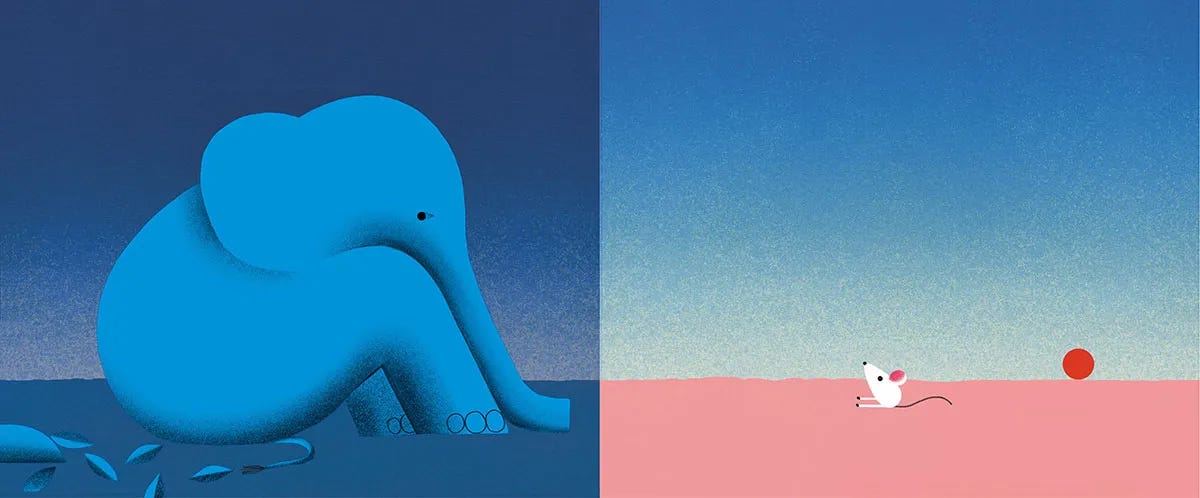
I believe in the power of children’s books to communicate profound truths and wisdom regarding the human experience. Such is the case with The Shadow Elephant, a tender picture book by Canadian author Nadine Robert and illustrated by Italian artist Valerio Vidali. They say the shadow of grief matches the height of love—the greater the love, the greater the shadow—and the elephant of this story finds himself in a big shadow. I checked out The Shadow Elephant from our public library this week and we passed it around the dinner table—each of us absorbing the story individually. While all the animals try to help the elephant feel better in their own unique ways, the only one who ends up being of any use is a small mouse. It’s a moving embodiment of everything Devine suggests in “How to help a grieving friend.” Acknowledgment is key—and, perhaps, this explains the key that appears in the moon on the last page of the book.

A key in the moon - from The Shadow Elephant Alan Sparhawk of the band Low just released his second solo album—this time with accompaniment from the band Trampled by Turtles and appropriately titled With Trampled by Turtles. It’s a unique paring—Low’s music is part of the slowcore genre and Trampled by Turtles is known for their blisteringly fast bluegrass. Back in 2022, Sparhawk lost his wife and bandmate Mimi Parker to cancer. After Parker’s death, Trampled by Turtles invited Sparhawk to sit in with them on some of their shows. Both bands being from Duluth, it was an easy way they could show up for their longtime friend and support him during his grief. In this moving and insightful Stereogum interview, Sparhawk discusses his first solo album White Roses, My God—along with his experience grieving the loss of Parker. One of the singles from his new album is “Not Broken.” Its chorus features a female vocalist—sounding uncannily like Parker—who sings over and over again, “It’s not broken. I’m not angry.” This vocalist, it turns out, is the daughter of Sparhawk and Parker—Hollis. The music video for the song shows Sparhawk continuing to grieve Parker beside bleak, choppy waters—but with a hint that he’s finding his way into healing, that he and Hollis are not broken and not angry, despite their pain. As grief goes on, that’s a hopeful place to be.

Thank you all for reading! I hope you found some inspiration for today’s moments, whatever they might be. If you enjoyed reading, go ahead and click subscribe to receive future newsletters.
If you know someone who might be interested in receiving this newsletter, please feel free to pass it along.
Be well and I hope to see you down the road sometime soon!
Eric

Love you, brother. Wonderful insights and thoughtful connections.