Maps and Mazes
Including animal poems, monarch butterflies, loons, brook trout, and a bug's view

Hola mi gente,
I love maps. Seeing where I am in the world and how I move through it fascinates me. Laying curved spaces out on a flat surface, though, requires distortion. Maps embed the biases of their makers—hidden perspectives that require a knowing observer to unearth.
Years ago I bought an upside-down map of the world that challenges the mental image we have of where countries are located and their relationships to one another. It’s amazing how simply flipping the poles of a map—while keeping the typography intact and right side up—can expose assumptions you’ve carried your whole life. In Jason Kottke’s latest newsletter, he mentions a new exhibit at the British Library in London called Secret Maps that gets at this very idea. Maps are more than just tools for navigation—they also “create and control knowledge.”
It occurred to me that maps are mysterious like animals are. They both obscure perspective. But while we can dig a little deeper to discover a map’s secrets, an animal’s perspective just goes on being mysterious. Thomas Nagel’s paper “What Is It Like to Be a Bat?” asserts that we can’t access an animal’s consciousness whereas Margaret Atwood’s essay “My Life as a Bat” imagines what it would be like if we could. Either way, I think attempting to see the world through multiple perspectives is a valuable practice.
So with that in mind, here are 5 connected things I thought were worth sharing:
Anna Tivel’s newest album Animal Poem is a beautiful and poignant commentary on the present state of our world. With her tender yet assertive voice, she invites listeners to see the world as it is—alive with contradiction and paradox. The opening track, “Holy Equation,” sets the tone for the rest of the album. “The math doesn’t add up,” Tivel sings, “there’s holes in the fabric of dreams you see right through. Good luck to the lucky few, and God bless the rest of us fools.” The title track follows and reminds us that, like birds flying a faithful dance, we are all just animals too.
High up silver howling bird
Looking down to see the world
Spinning out into the vast forever
Flying is a faithful dance
Animal suspended at the place
Where understanding touches vapor
- Anna Tivel in “Animal Poem”The New Yorker article “An Intimate Cartography of Costa Rica” looks at María Luisa Santos’s short documentary Direcciones, about the enigmatic and often humorous way Ticos (Costa Ricans) address their mail. There isn’t a centralized system for street addresses in Costa Rica, so instead people use reference points to get correspondence to its desired destination. The trouble is that “reference points” can include things like “the house with the red Toyota parked out front” or “up the stairs from where so-and-so’s dog is taking a nap.” Despite this apparent craziness, Santos makes an evocative point about how humans connect to place and to one another. To navigate life’s complexities, Costa Ricans rely on intricate communal bonds and shared memories carried from one generation to the next. She likens it to how monarch butterflies migrate over multiple generations—one generation flies north, dying along the way, and a new generation is somehow able to return to a place it’s never been before. There’s something uniquely intimate about navigating life in this way—something that loses its significance when exchanged for “efficient” systems and technologies.
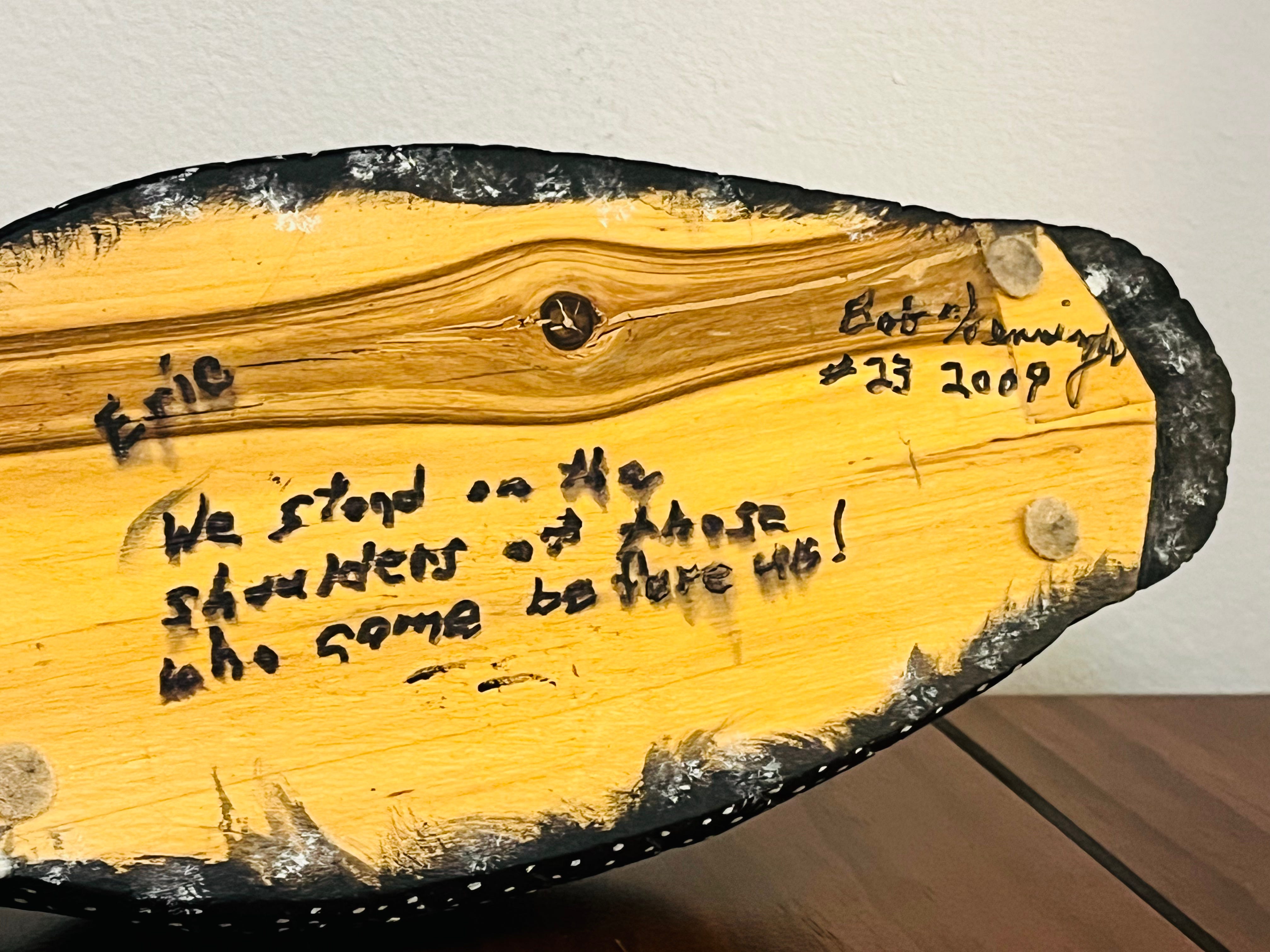
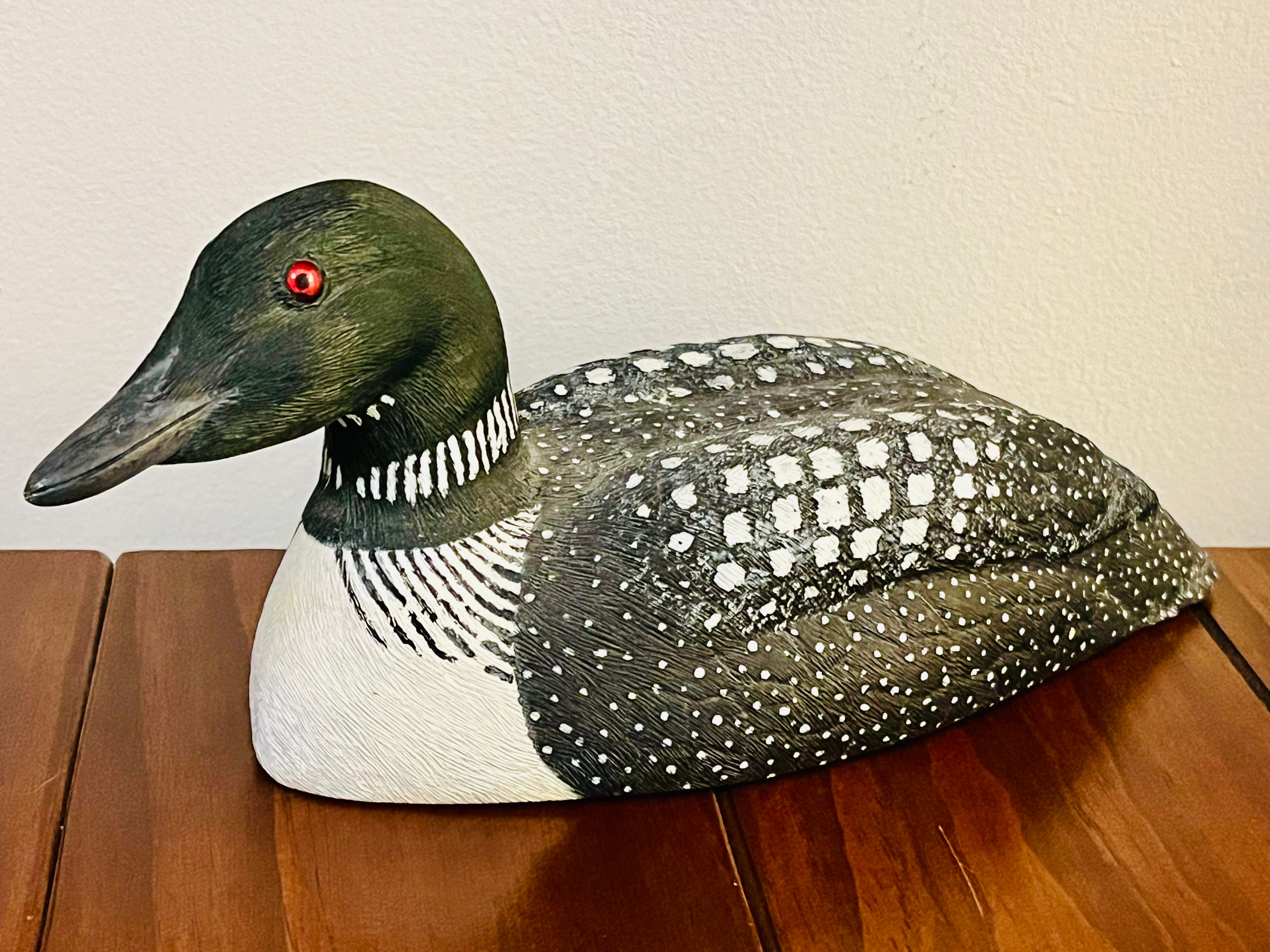
In Santos’s documentary, she talks about her grandmother and the pain associated with losing physical spaces and memory of them. It reminded me of my own grandpa, Bob Wenninger, who’s been battling dementia for a few years now. Before his mental decline, my grandpa was already living with a physical ailment that made his hands shake almost uncontrollably. Despite this, he cultivated a love for carving animals out of wood later in life, and went on to create beautifully detailed animal carvings for each of his seven children and multiple grandchildren. In 2009 he gifted me a loon with this quote on the bottom: “We stand on the shoulders of those who came before us.” I think of it often when considering how to carve my own path forward. I love you, Grandpa.
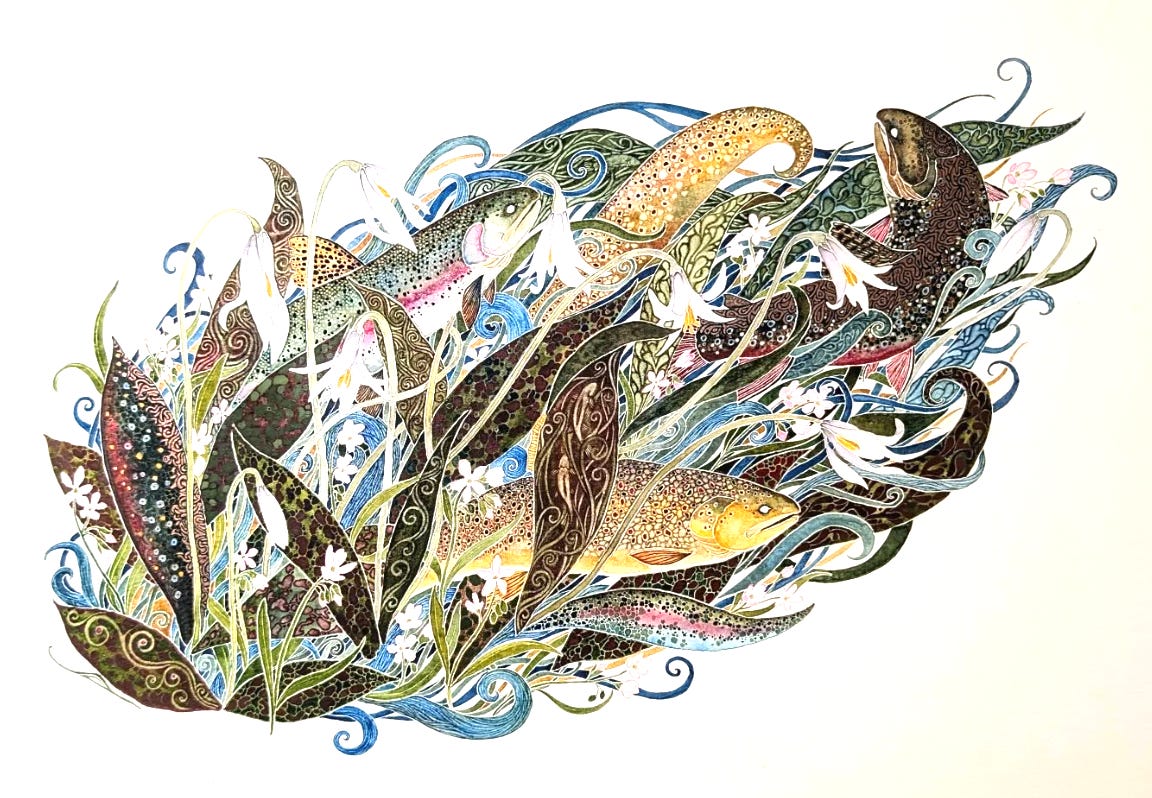
“Immersed In Memory,” by Pete Sandker A few summers ago, I read Cormac McCarthy’s The Road, a dark yet hopeful book about a father and son’s journey through a post-apocalyptic world. Pete Sandker’s watercolor painting “Immersed In Memory” reminded me of the cryptic paragraph McCarthy wrote to close his novel:
Once there were brook trout in the streams in the mountains. You could see them standing in the amber current where the white edges of their fins wimpled softly in the flow. They smelled of moss in your hand. Polished and muscular and torsional. On their backs were vermiculate patterns that were maps of the world in its becoming. Maps and mazes. Of a thing which could not be put back. Not be made right again. In the deep glens where they lived all things were older than man and they hummed of mystery.
Whatever McCarthy meant by this final passage, it instills in me a deep sense of humility—we are part of something bigger to whose mysteries we must submit, even as we pursue understanding amidst the chaos.
My son and I are seeing Jeff Tweedy perform in a few weeks. I’ve been psyching myself up by listening to a lot of Twilight Override (along with an abridged version I put together, Twilight Underride) and rereading parts of How to Write One Song. In a chapter called “Don’t Be Yourself,” Tweedy writes about reading books to his kids while working on A Ghost Is Born. He had a realization that many children’s books are written from the perspective of animals and decided to do the same with his songwriting. He writes that this “led to a semi-coherent Noah’s ark concept that shaped the rest of the album.” The song “Company in My Back,” for example, was “written from the viewpoint of an insect at a picnic.” Following the Noah’s ark theme, I thought “A Map for Vanishing Animals” provided a good visual for where in the world animals are threatened and endangered of becoming extinct. Props to Tweedy, as always, this time for considering their perspective.
Thank you all for reading! I hope you found some inspiration for today’s moments, whatever they might be. If you enjoyed reading, go ahead and click subscribe to receive future newsletters.
If you know someone who might be interested in receiving this newsletter, please feel free to pass it along.
Be well and I hope to see you down the road sometime soon!
Eric