

Poolside Philosopher
Including flow, Liniers, being water, mind tricks, and octopus teachers

Hola mi gente,
“Poolside Philosopher” is definitely a play on Armchair Expert, a podcast that highlights the messiness of being imperfectly human. In one way or another, we’re all amateurs in this life. The word “amateur” comes from the Latin verb amare, meaning “to love.” I think that being an amateur of activities, ideas, and relationships is something to be embraced—it means that we’re loving and pursuing love.
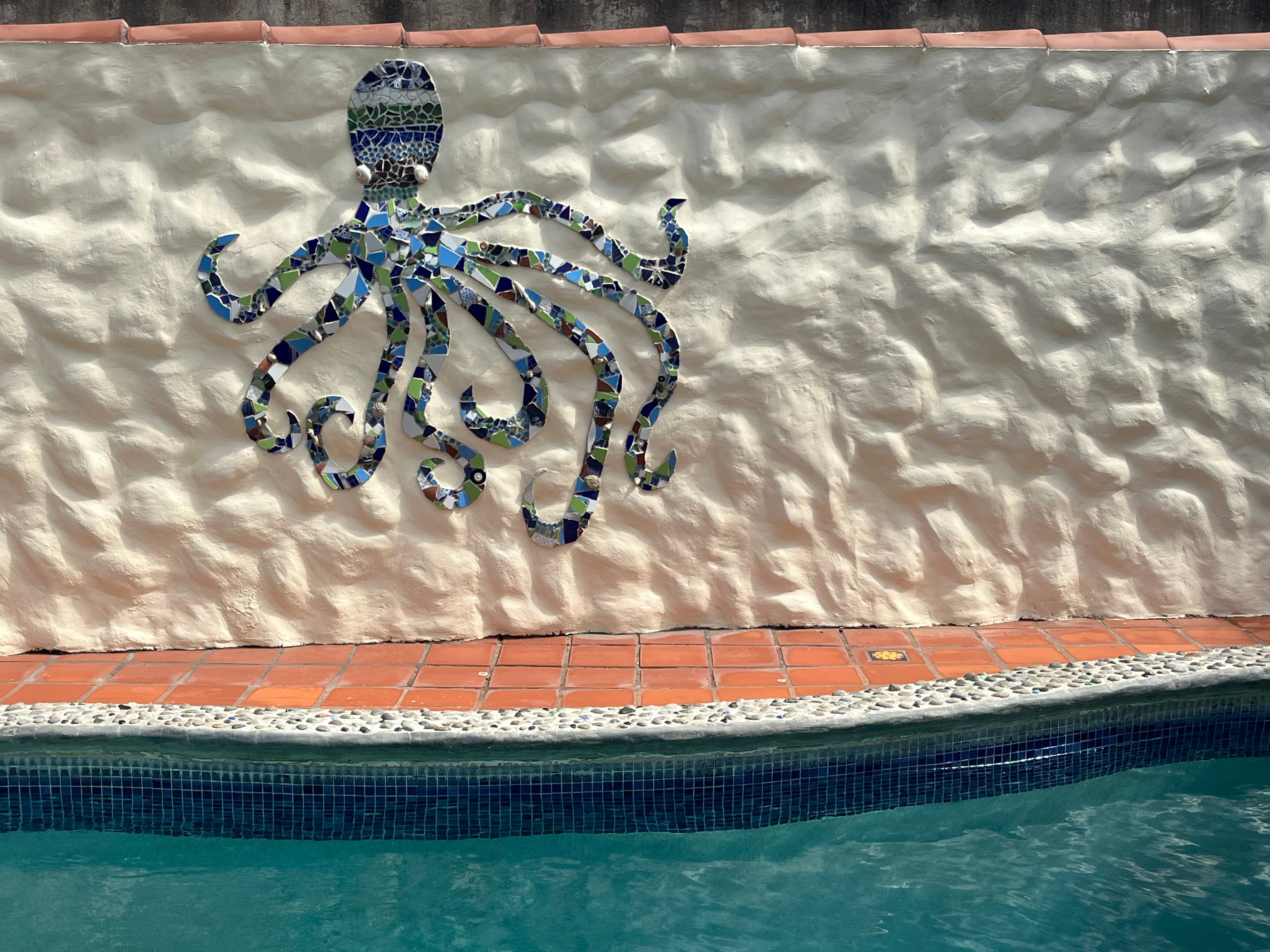
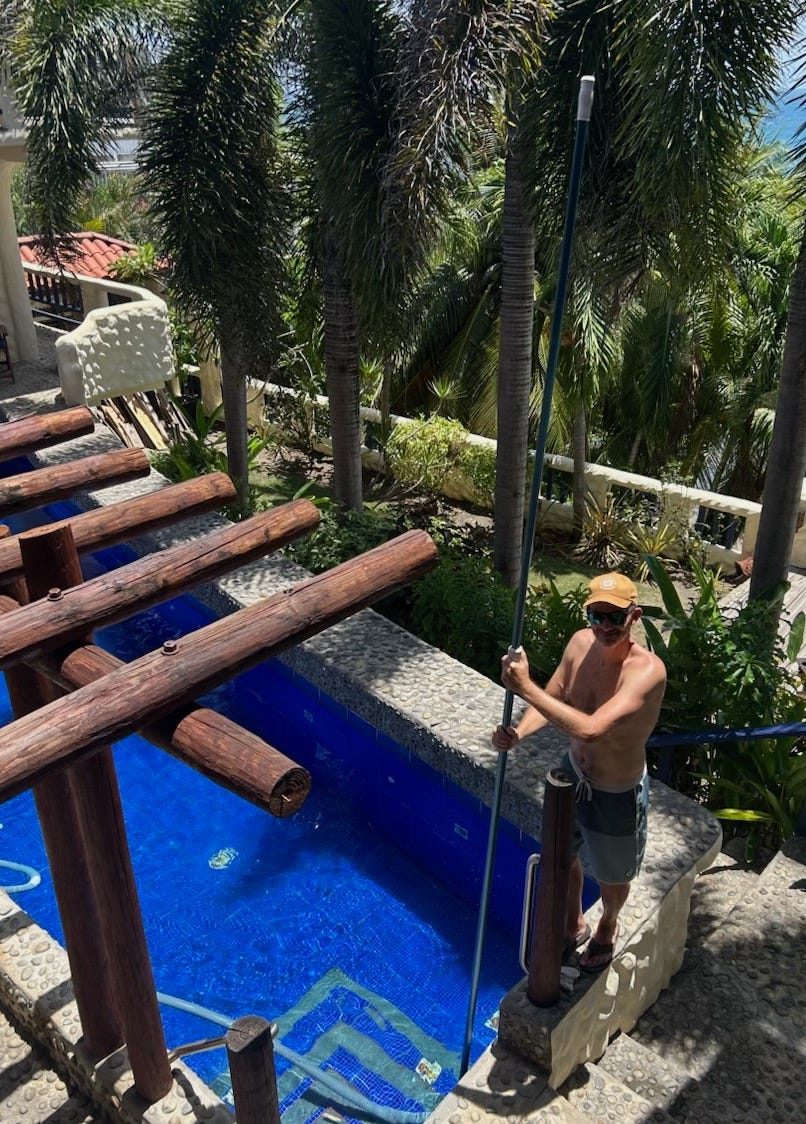
As it were, Angie and I have found ourselves in a unique situation. A few months ago, we became friends with a retired Canadian couple who’ve lived in Grenada for over a decade, have their Grenadian citizenship, and own an oceanside villa that they rent out to vacationers. They asked us to villa-sit while they’re off island for a few weeks, so here we are. And while Angie is busy studying for her final exams, I’m focused on pool and villa maintenance—and thinking.
The villa rests on the tip of a small peninsula so there’s ocean on both sides—and two pools. The sound and sight of water are everywhere. I love considering water and contemplating blue, so this week I’ve been waxing philosophical.
So with that in mind, this week I bring you 5 thoughts related to water and flow:
I loved psychologist Mihaly Csikszentmihalyi’s book Flow: The Psychology of Optimal Experience. It’s an important book that looks at how to achieve “flow,” or the ability to experience so much enjoyment in doing something that you have the positive feeling of losing yourself in the process. Most people in life want to be happy, but they have no idea what being happy looks like. Happiness is one of those things that’s achieved indirectly. I wrote about it this week in a post called “Look Away from Happiness.” What’s amazing about flow is that no matter your culture, age, profession, or any other demographic, it’s something that’s accessible to all. Cultivating a life of enjoyment and optimal experience is within everyone’s reach.
I first learned about Argentinian cartoonist Liniers from his book Lo que hay antes de que haya algo (What there is before there’s something), a terrifying children’s story that—in a style reminiscent of Where the Wild Things Are—addresses the inescapable fear born in moments of anticipation. You can experience a reading of the story in Spanish here. And the beauty of picture books is that you don’t have to know the language to follow along. The drawings of Liniers are wonderfully eerie and detailed. His work frequently appears in The New Yorker and his comic strip Macanudo has been running strong for over 20 years. He’s also a fan of Star Wars—May the 4th be with you! Like Maurice Sendak, Liniers isn’t afraid to dive into deeper topics with humor and wisdom. Another beautiful story I checked out this week—recalling both artists—was Pool, by JiHyeon Lee. It’s the story of two children growing through a shared adventure at a public pool—an opportunity for growth that others miss out on—and a superb example of how being in flow enriches our lives.
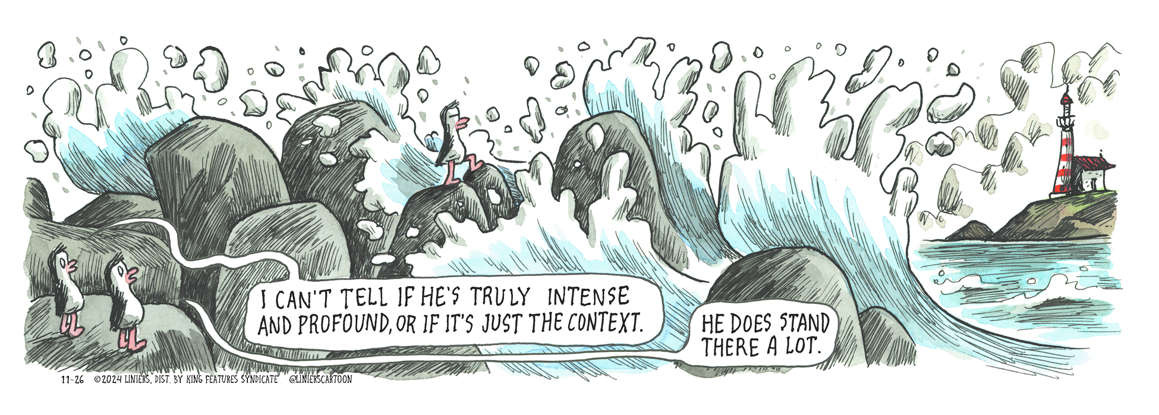
Are your motives intrinsic or extrinsic? (via Liniers) Those who find intrinsic value in an activity are more likely to obtain flow from it. As soon as attention turns toward gaining something external, one often falls out of flow. However, a key component of flow is the ability to adapt to whatever environment you find yourself in. Those who are able to see outside of themselves are more likely to experience growth of the self, particularly in response to life’s many stresses. Csikszentmihalyi writes:
It is difficult to notice the environment as long as attention is mainly focused inward, as long as most of one’s psychic energy is absorbed by the concerns and desires of the ego. People who know how to transform stress into enjoyable challenge spend very little time thinking about themselves. They are not expending all their energy trying to satisfy what they believe to be their needs, or worrying about socially conditioned desires. Instead their attention is alert, constantly processing information from their surroundings. The focus is still set by the person’s goals, but it is open enough to notice and adapt to external events if they are not directly relevant to what he wants to accomplish.
When we lived in Hanoi, Vietnam, I got a bookmark from Ginkgo T-shirts with Bruce Lee’s quote, “Be Water, My Friend.” Hearing the man say it himself is infinitely times better than reading it on a bookmark, but I still love that bookmark—such a valuable reminder. If we can be adaptable like water, we are more likely to find solutions to problems, and more ready to create flow experiences for ourselves.
When I was in grad school, I got a part-time job power washing houses in the suburbs of Minneapolis. At the time, I was training for the Minnetonka Challenge and would do open water swims in local lakes after work—a great way to enjoy the summer sun. I’m a strong swimmer, but the long distances started to cause me some swim anxiety. I found inspiration in Benjamin Hoff’s book The Tao of Pooh, and ended up using three specific mind tricks to help me find my “way”—1) I would have a pre-planned playlist of music in my head to combat any annoying songs that would pop in there, 2) I would focus on the movements of my arms going forward and the rhythm of my breathing, and 3) I would pretend that I was a fish and that the lake was my home environment. And it got me through. Even though I don’t regularly swim, I find it to be one of the most conducive activities for slipping into a meditative flow—like Detour swimming in the currents of his murals. I later put together a swimming calm playlist, which has helped me a lot during moments of high anxiety and pressure.
In the Netflix documentary My Octopus Teacher, filmmaker Craig Foster spends a year’s worth of consecutive days observing an octopus off the coast of South Africa. As they befriend one another, Foster learns many lessons from his teacher that renew his sense of purpose in life. He describes the octopus teaching him “to become sensitized to the other” and to realize “how vulnerable these wild animals’ lives are… how vulnerable all our lives on this planet are.” These lessons seem especially relevant in today’s cultural and political climate. The title of the film makes me wonder, “Who are our teachers?” To what and whom we pay attention will largely impact how we feel about our world and the lessons we learn there within. Foster’s experience paying attention to his octopus teacher led him to start the Sea Change Project, an organization dedicated to protecting nature and helping us remember that we’re all wild. Engineer and educator Mark Rober—founder of the STEM-infused build-a-toy company Crunch Labs—also explores the complexities of an octopus in the very entertaining “Octopus vs. Underwater Maze.” Definitely check it out.
Thank you all for reading! I hope you found some inspiration for today’s moments, whatever they might be. If you enjoyed reading, go ahead and click subscribe to receive future newsletters.
If you know someone who might be interested in receiving this newsletter, please feel free to pass it along.
Be well and I hope to see you down the road sometime soon!
Eric
Great read as usual. See you soon