

You're a Magic Station
Also, stories stalking writers, idea transfer, syncing up, and the untranslatable

Hola mi gente,
Lately, my morning routine has involved reading a page from each of two seemingly incongruous books: Lao Tzu: Tao Te Ching and The Pocket Guide to Action. The former offers deep wisdom on how to follow “the Way”—to exert less control over the stuff of life and instead accept its natural flow. The latter inspires readers to stop thinking about life and actually live it—to exert more control over life’s circumstance and shape the direction of its flow.
As an example, one section of the Tao Te Ching reads, “Following the Way daily you shrink. You get smaller and smaller. So you arrive at not doing. You do nothing and nothing’s not done.” Contrast that with the Pocket Guide: “Committing to action doesn’t end once you get somewhere. It means you never stop pushing.” The dichotomy is made strikingly visible in Yang Liu’s book East Meets West—a minimalistic comparison of her bicultural upbringing in China and Europe (see this article for a good sampling).
It has me wondering, though, about the balance between exerting control over life and just letting it happen. In reality, the Way of the Tao Te Ching encourages an active kind of passivity. Conversely, the Pocket Guide encourages a mindful and patient kind of action. The books are more alike than they seem. We might even turn the tables and say, “Action is the path, and acceptance is not passive.”
In the end, it’s a posture of readiness that really interests me. Are you ready to flow with uncertain river currents? And are you ready to swim if needed?
“Rain comes down like it always does.
This time I’ve got seeds on ground.”
- TV On The Radio
There’s a kind of magic in this world that acts upon us if we’re ready to receive it—like a radio station. If we accept that magic and then act upon it ourselves, it becomes a part of us and grows into something unexpected—something we might never have predicted otherwise.
So with that in mind, here are 5 connected things about tuning into the magic around you:
I’m a big fan of Neil Young, and I especially love his earlier archival concerts. Back in 2008, he released Sugar Mountain: Live at Canterbury House 1968, which was recorded just months after Buffalo Springfield broke up. Only in his early 20s at the time, the set reveals Young’s idiosyncrasies and raw vulnerability. But it also showcases his gift for writing and performing songs that pierce you to the core in a way only Neil can. Prior to performing “Mr. Soul,” Young discusses how it only took him five minutes to write the song. He goes on to say something that has stayed with me ever since I first heard it:
I don’t know if you believe in things like—ah, you must—you know, like things come to you, and all you are is sort of a—you’re a radio station. You know what I mean? You send out and it comes to you—you know what I mean. You’re a microphone. We all are, you know?
Inspiration does not choose favorites—it seeks only someone willing to receive it. And I believe that’s what you do with the magic that finds you. You receive it and you amplify it.
I’m reading James Gleick’s Time Travel: A History, and I loved this quote by writer Ann Beattie:
Writers don’t talk to nonwriters about being hit by lightening, being conduits, being vulnerable. Sometimes they talk that way to each other, though. The work’s way of getting itself written. I think that’s an amazing concept that not only gives words (the work) a mind and a body but gives them power to stalk a person (the writer). Stories do that.
The work personified and in control—what better way to describe the creative magic that happens when we allow ourselves to be moved by something beyond us. There’s something mysterious happening—something the person engaged in a creative practice knows that those of us who aren’t pursuing such endeavors don’t. In her book Bird by Bird, Anne Lamott describes it in a way that holds the writer accountable to play their part:
You don’t care about those first three pages; those you will throw out, those you needed to write to get to that fourth page, to get to that one long paragraph that was what you had in mind when you started, only you didn’t know that, couldn’t know that, until you got to it. And the story begins to materialize, and another thing is happening, which is that you are learning what you aren’t writing, and this is helping you to find out what you are writing.
In her TED interview, Elizabeth Gilbert shares a fascinating tale from her book Big Magic: Creative Living Beyond Fear, in which an idea leaves her and moves on to someone else. She recounts a very specific and detailed story idea that she had under book contract and was researching, when suddenly other pressing projects forced her to drop it. Gilbert eventually returned to her book project only to find that the vibrant life it once had was now gone. Shortly after, she met author Ann Patchett for coffee and asked about the projects she was currently working on. To Gilbert’s astonishment, Patchett outlined a story that exactly paralleled her own sidetracked project. The story would later become Patchett’s book State of Wonder, a novel completely her own, but also evidence of how ideas move around beyond rational explanation. In the TED interview, host Chris Anderson likens it to the tendency for scientists to make scientific breakthroughs around the same time but independent of one another—a phenomenon of multiple discoveries. When ideas and innovation are ready to emerge, it seems they find a way.
When trudging through unfamiliar territory, it’s helpful to look for road signs. Starting a new hobby or learning a new skill is at once thrilling and intimidating—the slightest indication you’re on the right path is always welcome. Writing is something I’ve always loved, but only recently has it become a practice I’m actively trying to cultivate. Just like making a big decision and getting confirmation it was the right one, I like it when I find out my ideas sync up with people I admire, even in very small ways. Last May I wrote about The Cure’s 1989 album Disintegration in my newsletter “Losing the Squeeze.” A few months later, I discovered that Austin Kleon had also posted about the album around the same time. It’s so cool to find yourself on the same frequency as your mentors—and I think a sign that we’re part of an unseen web of connection. Now that I’m back in Wisconsin, I was finally able to pick up Disintegration on vinyl at the one and only Inner Sleeve Records—now celebrating 50 years in business! I went with my buddy Ceps, who brought along his two boys and a neighbor kid, so we were a merry bunch indeed. It reminded me of an RSD visit years ago with my own son.
Sometimes there aren’t words to describe how we feel. In The Dictionary of Obscure Sorrows—originally a website—John Koenig names indescribable feelings by blending words and fragments of different languages. Moledro, for example, is the feeling of resonant connection with an author or artist you’ll never meet. Or silience—a combination of “silent” and “brilliance”—is a sentiment of which Koenig writes:
How strange that something so vibrant as art is so nearly invisible. Strange how rarely we look up at the architecture, or savor each bite of a meal cooked with care, or stop to pay attention to the music playing in the background, that’s far better than it has any right to be. It’s only after someone points it out, that you finally catch the tune. It makes you wonder if there’s brilliance all around you, hiding in plain sight, just waiting around to see if you’ll notice.
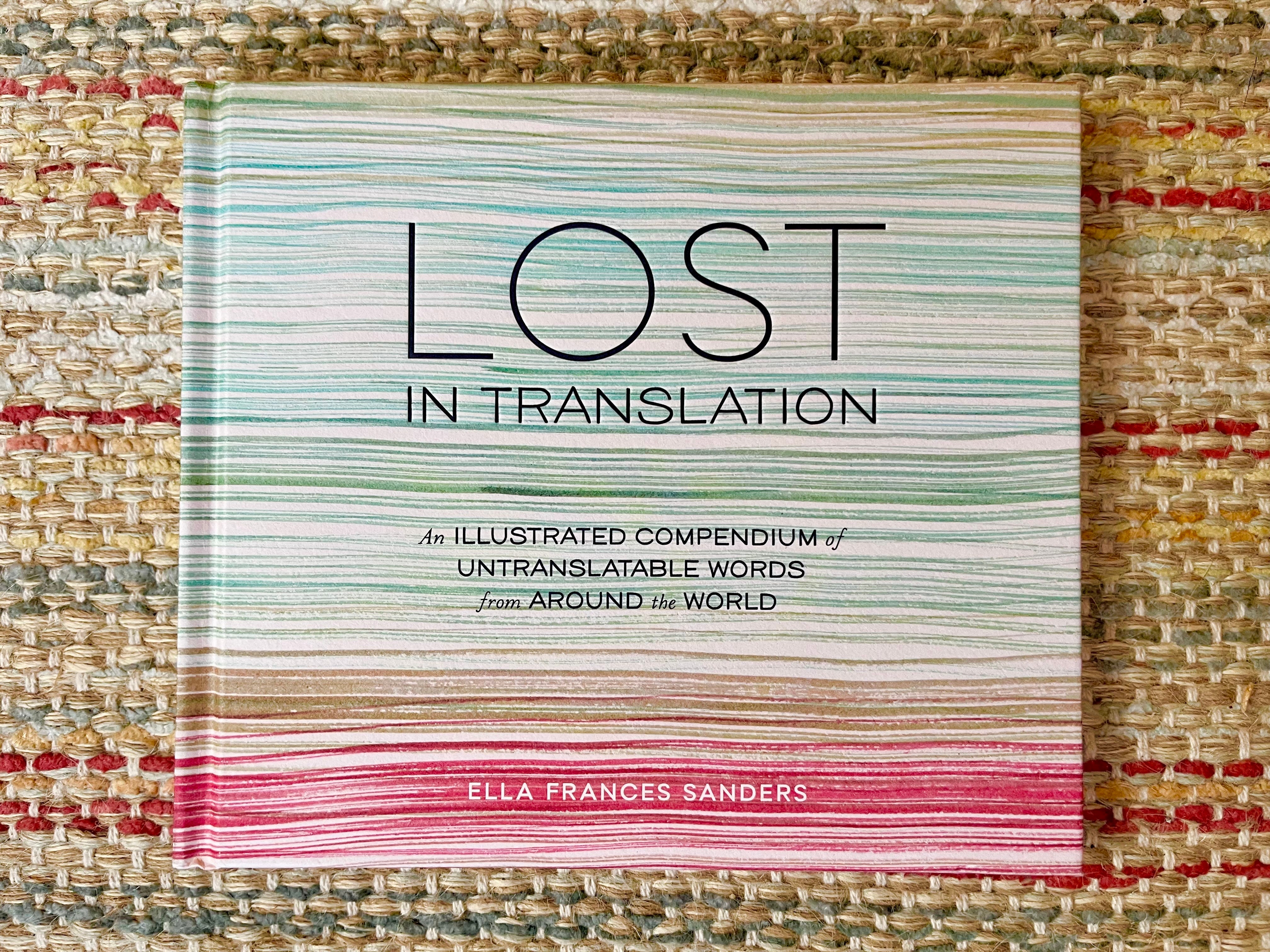
In the footnote for this entry, Koenig recalls how violin virtuoso Joshua Bell once busked in a subway station and went virtually unnoticed. Ella Frances Sanders, too, uses world languages as a window into our complex inner landscape. In Lost in Translation: An Illustrated Compendium of Untranslatable Words from Around the World, she includes words like nunchi (Korean)—the subtle art of listening and gauging another’s mind—and mamihlapinatapai (Yaghan, an indigenous language of southern Chile)—the silent acknowledgement between two people who share the same thought but are unwilling to initiate. This last word makes me wonder if magic is akin to a partner—a friend waiting in the wings for you to initiate, since you are the one living in a body.
Thank you all for reading! I hope you found some inspiration for today’s moments, whatever they might be. If you enjoyed reading, go ahead and click subscribe to receive future newsletters.
If you know someone who might be interested in receiving this newsletter, please feel free to pass it along.
Be well and I hope to see you down the road sometime soon!
Eric
I think the unifying concept here is 'resonance'. Add to all that youve mentioned the Platonic ideal; the collective unconscious and archetypes; and functional contextualism (the philosophical basis for ACT) and youve got a yearning to connect to something bigger than ourselves—what we typically call the spiritual realm. An attempt to try to make meaning, given our existence in this universe. I believe creativity is the most direct way to consider these resonances and express your feelings about them. When people ask me where my creative ideas come from, I guess I feel like I do pluck them from the imagination like they're already real things, yet not fully formed. I think thats precisely the creative artists job. To distill them down into some more accessible form. Like giving birth to something, new and fresh. Straight from the heart and with a dash of generosity.